What people mean by a cardboard cup
"Cardboard cup" is a buyer's term rather than a technical one. The cups in this collection are made from heavier paperboard than a basic paper cup. They are not made from the fluted corrugated board used in shipping cartons. Think of the gap between a thin water-cooler cup and the cup a good coffee shop hands across the counter.
The heavier board pays off in small, practical ways during a busy service:
- Fewer spills at the hand-off, because the cup does not pinch in when a customer grabs it quickly.
- Lids seat properly, since the rim stays round instead of going slightly oval.
- Cups stand up in a four-cup carrier or a car cup holder without leaning.
- A full cup can sit on a desk for half an hour and still feel the same when it is picked up again.
If your drinks are served and finished at a table in a few minutes, a lighter cup may be all you need. If they travel, wait on a desk or get handed through a drive-thru window, the heavier wall is worth it.
Choosing between the three cups in this range
Cardboard Coffee Cups
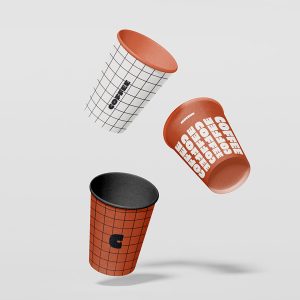
This is the everyday hot-drink cup: drip coffee, lattes, Americanos, tea and hot chocolate. Choose it when the cup is your main piece of branding, seen by every customer at the counter and by everyone they walk past afterward. It suits cafes, bakeries that serve coffee and office coffee bars.
Cardboard Cups With Lids
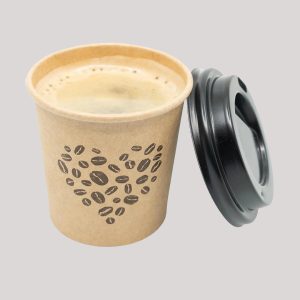
Here the cup and lid are ordered as a matched pair, so you are not guessing whether a stock lid fits your rim. That makes them the safer choice for anything that leaves the building: delivery, catering drop-offs, curbside pickup. Our cardboard cups with matching lids are the one to pick if a lid popping off in a bag would cost you a refund.
Small Cardboard Cups
Small cups do jobs a full-size cup cannot: espresso, coffee tastings, dessert bites, sauces and free samples at a market stall. Because the wall is firm, a small cup does not crumple when someone pinches it between two fingers. Roasters and bakeries often use our small cardboard tasting cups to hand out samples with the brand still visible.
Cardboard, standard paper and kraft cups compared
| Cup type | Wall feel | Best for | Print look |
|---|
| Cardboard cups (this range) | Firm, keeps its shape | Takeout coffee, delivery, premium cafes, tastings | Crisp detail; suits foil and embossing |
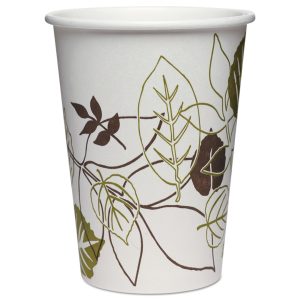
| Standard paper cups | Lighter, flexes more | Water stations, offices, quick events | Good for simple logos |
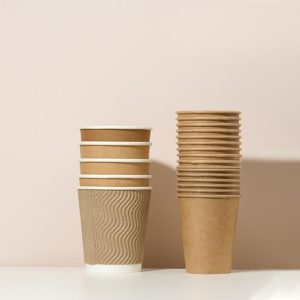
| Kraft cups | Depends on the board; natural brown face | Brands with a rustic or eco look, farmers markets | Muted; strongest with dark ink |
Material and weight are two separate decisions. You can have a firm cup with a white face for bright colors, or a natural-looking cup in kraft. If you are still deciding on the stock itself, browse our paper cups sorted by material to compare recyclable, kraft and other options side by side.
Getting the print right on a firm cup
A cup is a tapered cone, so the flat artwork is a curved fan shape, not a rectangle. Straight lines and text bend slightly when printed flat and then straighten as the blank is wrapped. This is why we send a digital proof before printing. Check it closely around the side seam where the blank overlaps; keep your logo and any small text away from that line.
Some practical choices for this range:
- CMYK or Pantone. Full-color photos and gradients print in CMYK. A logo that must match your signage exactly should use a Pantone (PMS) color.
- Finish. Matte feels like paper and hides fingerprints. Gloss looks bright under display lights. Spot UV on the logo only gives a subtle contrast you can feel.
- Foil. Gold, silver or rose-gold foil looks best as a small accent, such as a logo or a thin band, rather than a large area.
- Grip zone. Customers hold the lower middle of the cup, so put the logo higher or repeat it on both sides.
Prefer the brown look? Our printed kraft coffee cups take one- and two-color logos well, though bright colors will look darker on brown board than they do on white.
Planning the accessories around the cup
A cup rarely goes out alone. Before you order, picture the whole hand-off: the cup, the lid, maybe a sleeve, maybe a carrier for a four-drink office run, and a bag if food comes with it. Each of those pieces either matches your brand or does not, and customers see them all together.
Lids are the part people get wrong most often. A lid that fits loosely leaks when the cup tips in a bag, and a lid that is too tight cracks when a busy barista presses it on. Ordering cups and lids together, sized to the same rim, removes the guesswork. Sleeves are worth adding for the largest hot sizes, even on a heavier cup, and they give you a second place for a seasonal message without reprinting the cups.
If you sell a lot of multi-drink orders, think about how the cups sit in a carrier. Firm cups stand straighter than soft ones, which helps, but the base diameter still has to fit the carrier slots.
Ordering cardboard cups, step by step
- List the drinks or foods each cup must hold and the sizes you serve them in.
- Decide whether you need lids, and for which sizes. Lids are matched to the rim, not the volume.
- Send your logo, brand colors and any wording, or ask our team for free design help.
- Request free samples. Pour your hottest drink, put the lid on and leave it for ten minutes to see how the wall and rim hold up.
- Approve the proof on the cup template.
- Production runs 4–6 business days after approval, with rush options for launches and events.
- Track how many cups you use per week and set a reorder level well before you run out.
The minimum order is 100 units, and volume discounts kick in as quantities grow. Shipping is free to the USA, Canada, the UK and Australia. Cups nest, but they still take more shelf space than flat items like sleeves, so plan storage for a dry spot away from the dishwasher steam. You can also attach your artwork with the step-by-step order form on this page when you request a quote.
Where cardboard cups make the most sense
Drive-thru coffee is the clearest case: the cup goes from your hand to the customer's hand to a car cup holder, and a soft cup fails at one of those steps. Specialty cafes use the heavier wall because it matches the price of a craft drink. Office caterers like it for coffee service that sits on a meeting table for an hour. Bakeries pair a firm cup with a pastry bag for a breakfast order, and coffee roasters bring small cups to farmers markets for tastings. If cardboard cups only cover part of what you serve, the rest of the full custom paper cups range covers cold drinks, food portions and seasonal designs.


 Ice Cream Cone Sleeves
 Waffle Cone Sleeves
 Ice Cream Cone Wrappers
 Crepe Cone Packaging
 Sugar Cone Sleeves
 Custom Printed Coffee Sleeves
 Cake Cone Sleeves
 Cardboard Cone Sleeves
 Black Cone Sleeve
 Child Size Waffle Cone Sleeves
 Paper Cone Sleeves
 Small Cone Sleeves
 Eco-Friendly Cone Sleeves
 Aluminum Foil Cone Sleeves
 Two Color Cone Sleeves
 White Cone Sleeve
 Polka Cone Sleeves
 Abstract Cone Sleeves
 Rolled Cone Sleeves
 Chicken Cone Sleeves
 Custom Waffle Trays
 Ice Cream Cone Holder
 Paper Mache Cones
 Custom Bakery Trays
 Custom Cardboard Food Trays
 Custom Dessert Trays
 Custom Hot Dog Trays
 Ice Cream Cone Tray
 Custom Burger Trays
 Custom Combo Meal Trays
 Custom Fries Trays
 Custom Crepe Trays
 Burger Sleeves
 Custom Burrito Sleeves
 Custom Crepe Sleeves
 Custom Dessert Sleeves
 Custom Donut Sleeves
 Custom Tray And Sleeves
 Food Sleeves
 Chocolate Bar Sleeve Packaging
 Custom Bento Sleeves
 Custom Cupcake Sleeves
 Custom Die-Cut Sleeves
 Custom Hot Dog Sleeves
 Custom Cold Drink Sleeves